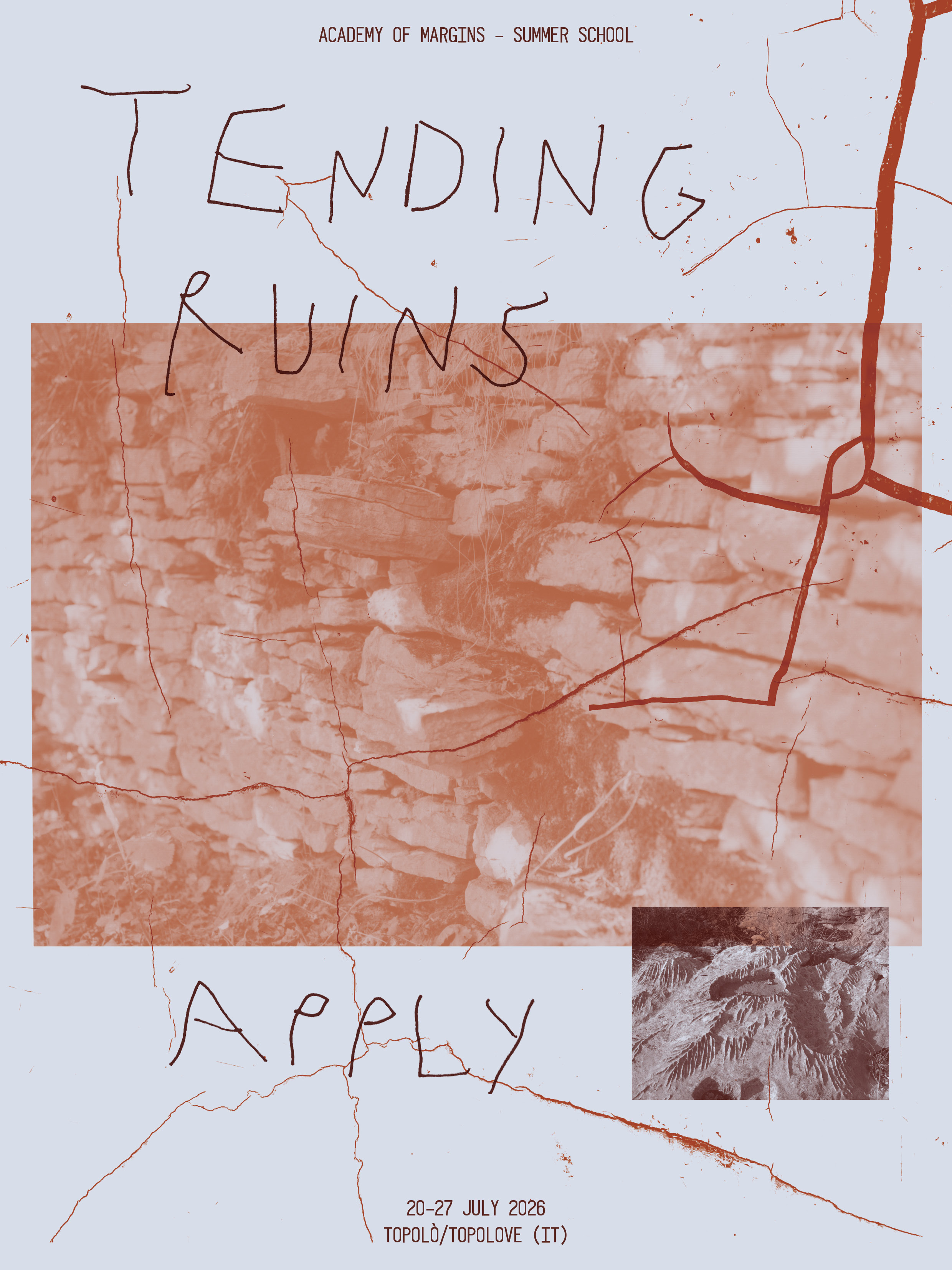
Academy of Margins – Summer school 2026
Tending Ruins
Topolò/Topolove, Monday 20.07 – Monday 27.07
Deadline – 24.06.2026
Results – 01.07.2026
–
Robida is welcoming everyone to the 5th edition of the Academy of Margins!
The Academy of Margins is a long-term project initiated by Robida in 2022: it was conceived as a learning platform that stimulates collaborative and discursive learning and is based on intimacy and rootedness where the margins are not only the site but also the widely intended content of the Academy itself.
The Academy of Margins transforms Topolò/Topolove (IT) into a learning site, where one can put in relation different knowledges brought to the village by researchers, professors, activists, artists who encounter the place and the landscape and are transformed by them. Contents are situated in the place, adapting to it, changing through it: the context ceases to be the scenery of learning, and becomes a participant to the development of reflections, questions and knowledge articulations.
The Academy of Margins intertwines practical workshops, such as learning how to repair dry stone walls, how to carve wood or how to code a website, with theoretical seminars, lectures, or reading groups.
Since its first year, the Academy of Margins also hosts a summer school. Each edition of the summer school has experimented with different pedagogical models, from traditional roles of teacher and student to co-created, horizontal formats. The Academy embraces learning in between moments: while braiding hair, napping under trees, swimming, or cooking together. By fostering entangled relations between people, place, and theory, it explores how ecology, art, and thought can become indistinguishable from life itself.
Joining the Academy of Margins’ summer school means joining the present research, questions, doubts and experiments of the collective, while also join Robida in its everyday life!
The program of the Summer School of Academy of Margins 2026 will revolve around one of Robida’s most troubling and intriguing topics, both theoretically and practically: ruins.
→ Read the whole application and the guidelines here
→ Apply through the dedicated google form
The context: Zetova hiša
In 2025, we bought a ruin. As every house in Topolò it is called by its family name, Zetova hiša. We also often call it by the surname of its last inhabitant, Gubana. We bought it to save it from other buyers who could have potentially distastrous plans with it but we bought it also because Zetova hiša has always been a place for our dreams and for little practical actions. Years ago, we squatted its yard, cutting the overgrown vegetation and transformed it into a vegetable garden, humble and messy. Then we planted some fruit trees. We tried to transform one of its cellars into a chicken coop but the operation quickly failed, and all the chickens were eaten by a fox who found a whole to enter the room. This year we installed three bee hives in the upper part of the garden.
We mainly spend time around the house, planting, sowing, cutting stubborn robida (eng. brambles) branches which return every month, fixing the compost, harvesting plants we planted and foraging wild ones. We hang out in the space adjacent to the house, since the building itself is too dangerous to be used or walked in.
In 2019, Janja included it in her architectural masters thesis about Topolò where she proposed to renovate it into a common living room for the community. In 2021, we organised a little symposium on artist residencies and the house became the center of reflections around dwelling, shared spaces and we re-imagined its function as that of a toolbox or a pocket knife. We continued thinking about it as our future common space, where we could store our books and watch films in winter, as a studio, as a place for residencies, or as a workshop.
But beside the specific ruin we bought, we are interested in this topic because the whole village of Topolò/Topolove and the landscape surrounding it can be considered as a not-yet-ruin. Many of the buildings are abandoned since many years and are on the verge of collapse. The thriving forest overgrew the terraced fields which were once cultivated: traversing the forest, one can discover the archaeology of rural Topolò, with dry stone walls drawing horizontal lines in the landscape, today covered by trees and ivy. Also the local culture, both the material and the immaterial one – such as the Slovene dialect, the old toponyms, the songs and rituals – is a ruin, slowly being forgotten, with small pieces disappearing every time an elder member of the community dies.
We know the fragility of ruins and the pain that hovers around them.
We don’t romantize them looking at them from afar, but we stay close to them.
We find them beautiful and try to learn from their teachings. During this Academy of Margins Summer School, we would like to extend this invitation to stay close and listen to their teachings also to you.
The topic: Tending Ruins
During this Summer School, we will dwell together in words that circulate around the notion of ruin, such as erosion, weathering, decay, decomposition, disintegration, dissolution, collapse, surrender, allowance. But also in words that refuse to let ruination become the only story: repair, desire, dream, reactivation, resistance.
We call tending the practice of moving between these words. Tending means remaining close to what is exposed to ruination, decay, interruption, and change, without turning away from loss, but also without allowing loss to become the only horizon. It is a way of staying with instability while nurturing what persists, what resists, what dreams, and what continues to compose worlds despite their fragility.
The Summer School on Tending Ruins will offer time and space to explore these questions together. The program will unfold through workshops, walks, listening sessions, readings, field experiments, and shared meals, shaped by three thematic sites to which participants are invited to respond with their own activities. These categories are not strict but fluid and overlapping invitations, so please take them as such: Ecological Ruins, Built Ruins, and Cultural Ruins. You can of course propose activities which do not fit into any of these, if you still think they correspond with the overarching topic of the Summer School!
As in previous editions, we invite participants to apply to the Summer School by proposing activities, workshops, lectures, experiments, presentations, or discussion formats that explore the theory and practice surrounding ruins. We welcome both theoretical contributions and hands-on formats, and we encourage proposals that combine the two. Since the three thematic sites are conceived both as conceptual and physical places, we will help you situate your activities around the village, if needed. We don’t expect you to propose a situated practice since many of you have never been to Topolò. Where your proposed activity will happen can be discussed and imagined together, later on!
The topic: Thematic sites
1. Ecological ruins
What lessons of abandonment and abundance do meadowed ruins teach us?
In the middle of the thick forest, we meet the ruins of the past landscape. They appear as revelations – sudden light in the dark forest we traverse: clearings, traces of past meadows. They are still covered by grass or inhabited by old fruit trees. The writer Maria Sledmere, reflecting on meadows, in her book Midsummer Song (2024) writes that “to meadow is to go into mourning and dream”. Maybe to go into mourning and dream is also what all ruins ask of us: not to overlook why they appeared, to know their genealogy, to grief and honour their previous lives but at the same time not to focus only on the “teleological trajectory of pain, brokenness, repair”, as Eve Tuck and K. Wayne Yang argue in the text R-Words: Resisting Research (2014), but instead to dedicate space to desire and dream.
In these minute ecologies – in a sudden little patch of grass in the forest, beside a last fruit tree resisting among brambles, in a stubbornly cut meadow, near a trace of an old garden or a once-cultivated vine growing widely on the ground – we encounter ruins as tense places between abandonment and abundance.
This site dreams of being activated by practical workshops that engage with the spontaneous vegetation growing in the meadowed ruins, botanical explorations, writing exercises, listening, smelling, tasting experiments. But it also welcomes moments where to think about ecological loss and dream in general or lectures, presentations, or readings about ecological ruins and reparative practices from elsewhere.
2. Built ruins
Are built ruins the material trace of a way of life that has been displaced from existence? Could ruins be interpreted like wor(l)dless archives, which tell stories of gestures, building techniques, and modes of being that have formed a place?
In recent decades, the number of human inhabitants in Topolò have steadily dwindled, giving rise to a profusion of ruins. Yet, this process was accompanied by gradual repopulation by non-human beings. Who are the new dwellers of old stone houses, half-collapsed drystone walls and kozolci (hay-racks) around and beyond the village? And what can we learn from the symbiotic relation between the new and the old?
From ancient practices of spoliation, where parts of old buildings were reappropriated due to their symbolic value, to the reality of squatters, who bring new vitality to abandoned buildings, the ruin challenges us to consider what to preserve and what to let go of. Are there forms of living with ruins that embrace deterioration, incompleteness and fragility? How can we activate a ruin without erasing its layers and contradictions?
This site focuses on building and unbuilding, practices of restoration, workshops on material cultures, exercises in deliberate incompleteness and reflections on vernacular construction techniques and the (ruined) knowledge systems embedded in them. We are interested in approaches that make parallels between the reality of Topolò and other situated cases, critically analyze the fate of ruins elsewhere and speculate about the permanence and transformation of obsolete typologies.
3. Cultural ruins
What happens when worlds disappear – and how do we resist their disappearance?
The ruination this Summer School seeks to reflect on is not only strictly material but also cultural, linguistic, and political. Dialects fade, rituals dissolve, and collective life-worlds are ruined by (forced) emigration, borders and their violent reconfigurations, wars, ethnic cleansings and genocides, standardisation, extraction and other demands of the “storm” called progress — a force that propels us into the future, while the debris before us grows skyward, as Walter Benjamin put it.
But cultural ruination is not only a story of loss; it is also a messy field of resistance, reactivation, and stubborn continuity with what remains. We are interested in practices and theories that stay with the cultural remnants of this storm: broken continuities, partial survivals, deliberate refusals, and forms of knowledge that persist outside dominant narratives of development and innovation.
This site welcomes lectures, presentations of projects and practices, preformances, and workshops that engage with disappearing languages and dialects, rituals and storytelling as world-forming methodologies, and the crumbs and scraps of local cultural systems — as well as historical and contemporary practices that actively resist cultural erasure and insist on the possibility of continuing otherwise. We explicitly invite participants to bring stories and practices from their own contexts and geographies, to be shared in Topolò and placed in dialogue with the histories, landscape, and forms of life that shape our village.
→ Read the whole application and the guidelines here.
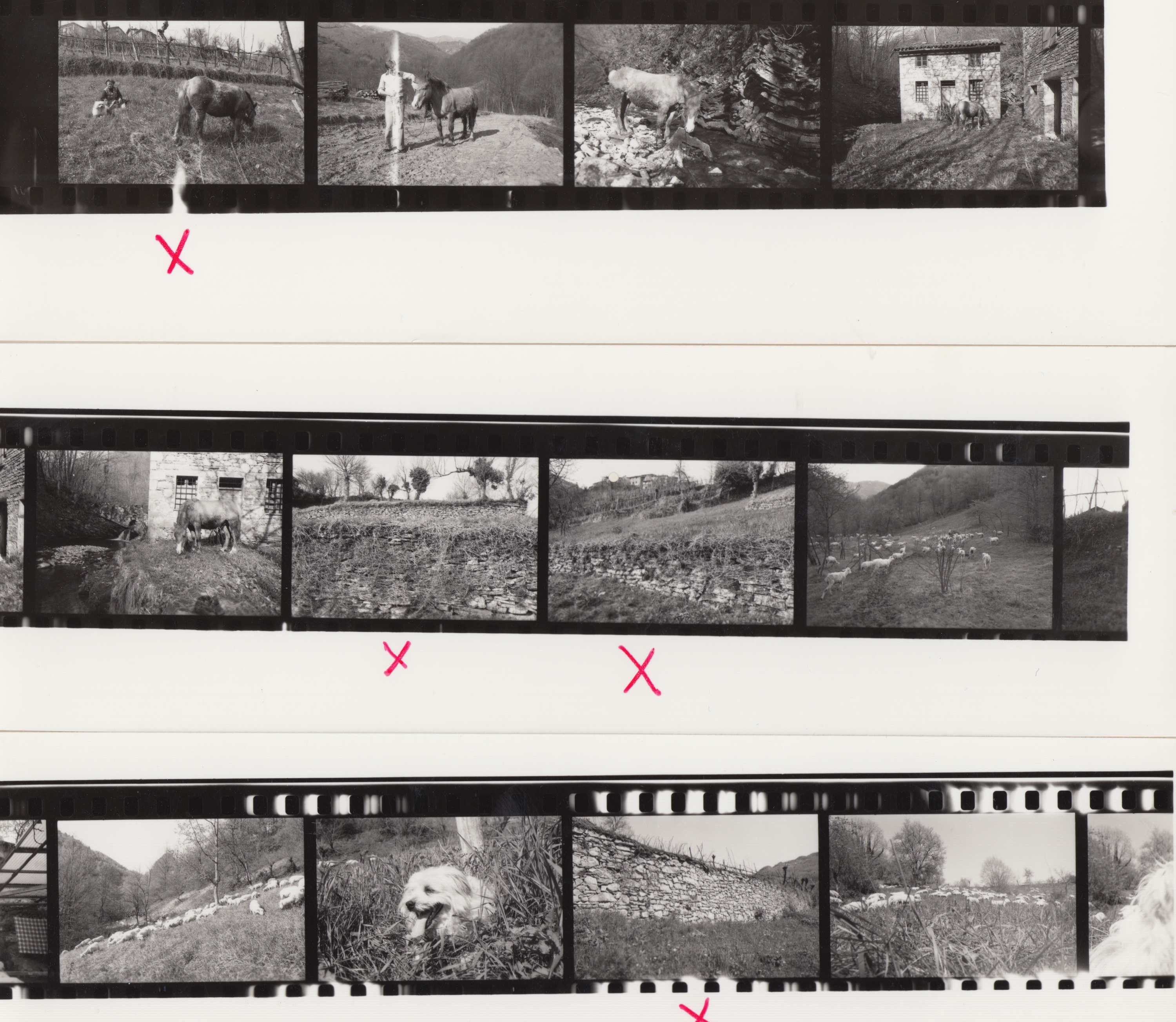
→ Ecological ruins: The last meadows of Topolò, photographed by Renzo Rucli in the ‘80s. We see a horse plowing the soil, sheep grazing, a dog and intact dry stone walls.
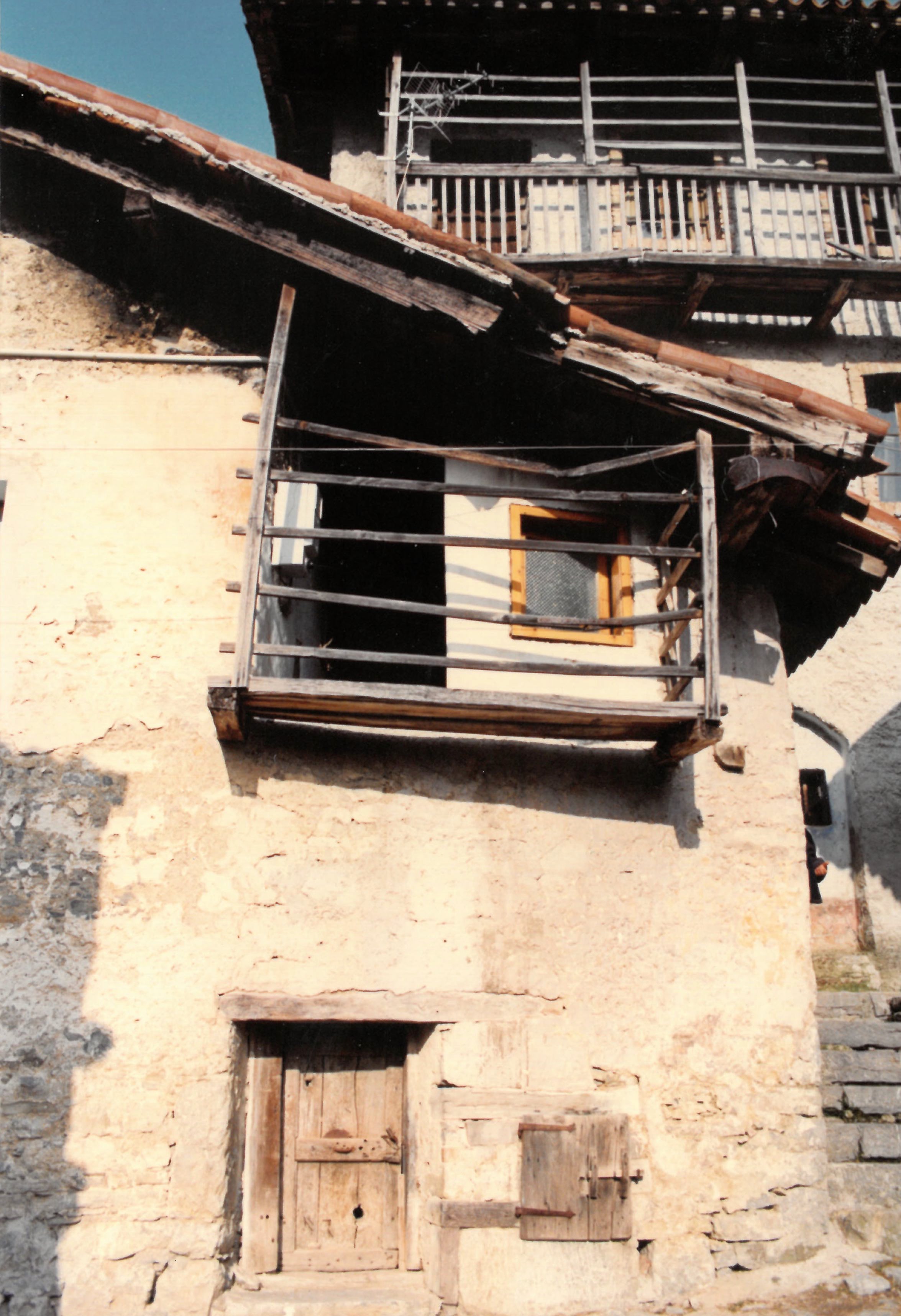
→ Built ruins: “Gank”, the wooden balcony where the harvested crops were dried. But also a place to read, to rest, to observe the landscape. Source: Novi Matajur
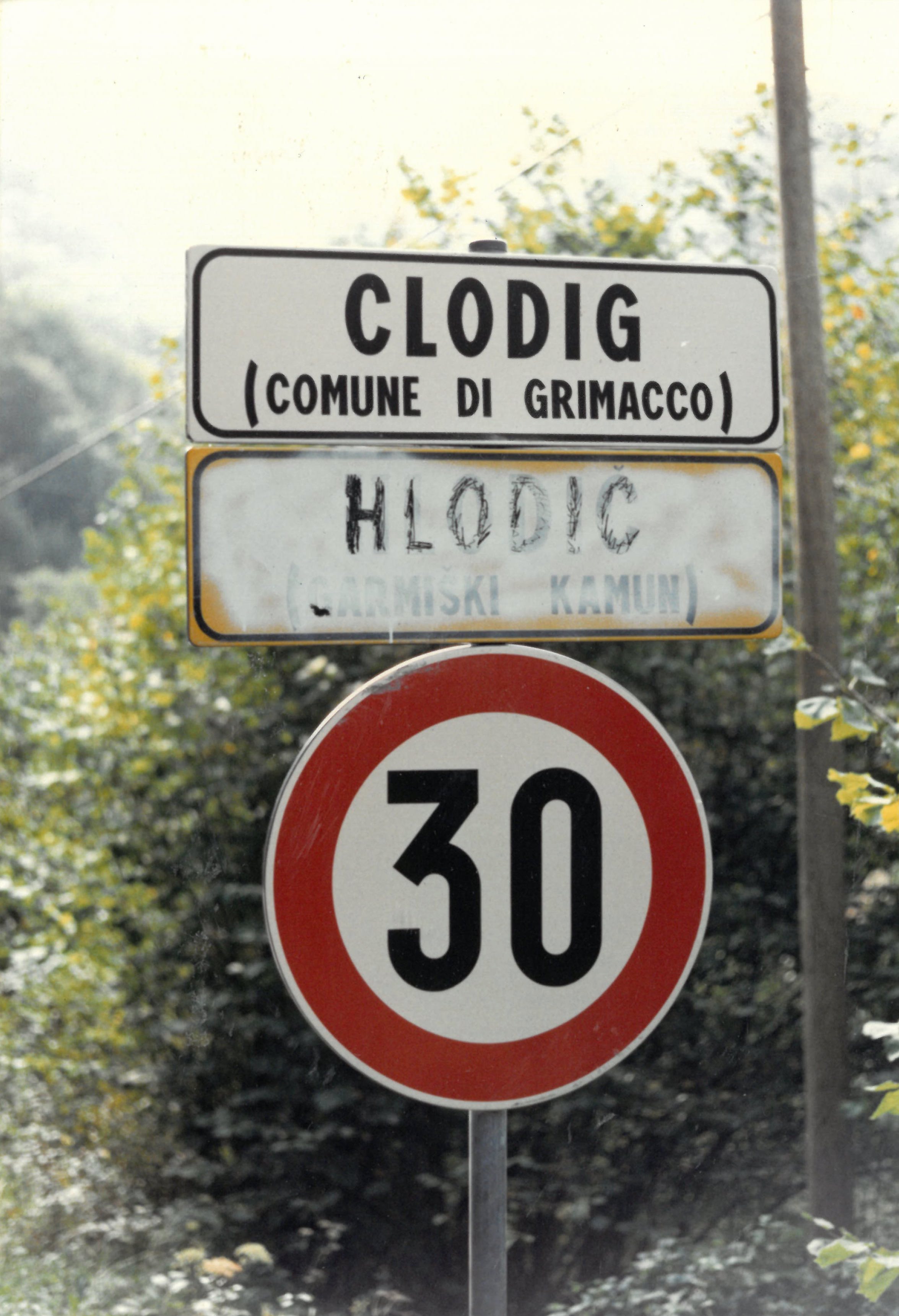
→ Cultural ruins: The photograph shows the whitened and erased Slovene name of the village Hlodič/Clodig in the municipality of Grmek/Grimacco, which also Topolove/Topolò is a part of. It represents one of the visible manifestations of the long-standing political violence against the Slovene community, its language, culture, and presence in this area. Source: Novi Matajur
P.S. We want to thank Anna Andrejew for the ruins traces we used in the images of the call!