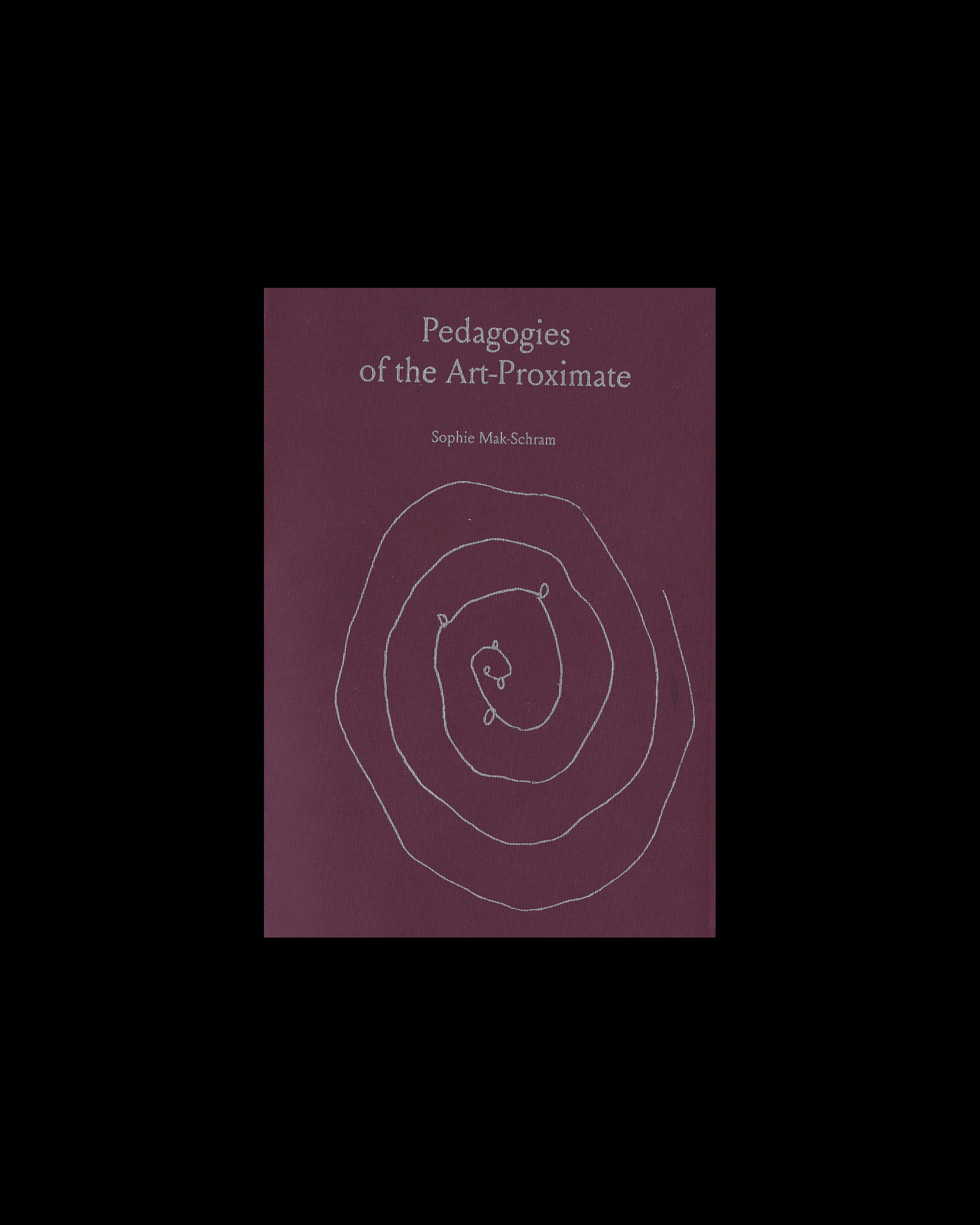
Pedagogies of the Art-Proximate
Sophie Mak-Schram
Released in September 2026
Find it at Dear Books book fair in Amsterdam
Pedagogies of the Art-Proximate reflects on the changing landscape of contemporary art’s relationship to formal education, through tracing a history of theories, practices and protests across the twentieth century. In a context of educational funding crises, cuts, and changes, and within a wider frame of shifting understandings of how we know things and who or what we learn from, what can learning mean and in what ways can it happen?
Going beyond a simple chronology of art schools, this book considers the many ways in which art and education meet: how museums learn from those they invite in, how art objects become pedagogical tools, and what happens when a school is an artwork (or vice versa). The book proposes art-proximate practices as a new term for an increasingly blurry realm of practices that include socially engaged art, relational art, and activist art, as well as ‘non art’ forms. Weaving together auto-ethnographic, art historical and educational studies, Pedagogies of the Art-Proximate is about what art puts us in the way of learning – and why that might be politically, socially, and critically urgent today.
Thoughts about the book:
This book lures us to learn with others who also learn, positioning us in close proximity to art and one another. In these times lamented for the lack of political imaginaries that would offer viable alternatives to global neoliberal authoritarianism, this is an exciting proposition. This study brings forth multiplicity of concrete aesthetico-political educational experiments that pivot around collective imagining of the world otherwise. To think how things are, imagine how they could be otherwise, and then live with others such imaginaries, as if it were possible. Against all odds and in spite of everything.
– Maria Hlavajova
This book offers a set of critical analyses and embedded learnings that develop tools to reground socially engaged practices’ potential as a form of liberatory practice. It has been of tremendous value to me to deepen my understanding of my own and others’ practices, and guided my thinking around unbuilding and rebuilding cultural infrastructure as an expanded political space of learning: something to be done in proximity, with difference. We need this now more than ever in this moment of rising fascisms, ecological catastrophes and predatory capitalism.
– Jeanne van Heeswijk
Languages: English
Pages: 368
Size: 120x170mm
Papers: Holmen Book Cream 70g 2.0, GF Smith Claret 170g
Published by Robida in August 2026.
ISBN 978-88-945349-5-5
This project has received funding from the European Union’s Horizon 2020 research and innovation programme under the Marie Skłodowska-Curie grand agreemet N. 860306.
H2020-MSCA-ITN-2019
This book is supported also by the project Academy of Margins 2026, financed by Regione Friuli Venezia Giulia.