RAD Coobook (Elena Braida, Agnese Politi, Rosita Ronzini)
Writing Method Note: Given the grassroots, precarious and scattered nature of RAD Cookbook, we decided to respond to the invitation to contribute to Robida’s web journal through an exquisite corpse. The text develops sequentially across three voices. Each person writes from her own experience of the stay in Topolò, receiving only the closing passage of the previous contribution. Rather than producing a single retrospective account, the method allows memories, frictions, images and questions to pass from one person to another, changing as they are received.
The resulting text is intended as a form of collective sedimentation: a way of tracing not only what RAD Cookbook may have left in Topolò, but what the experience has shifted within our individual and collective practices.
RAD Cookbook in Topolò, 6–12 July
During the week of 6–12 July, we, the RAD Cookbook collective formed by Ele B., Rosita, and Agnese, took root in Topolò, moving between practice and research while tending to the Dindin series and IZBA’s opening hours through moments of conviviality.
As we gathered in person, those days became a gift, shaped by challenges, shared responsibilities, and collective way-finding. We shared the daily rhythms of life in Topolò, moving between work and leisure, cooking together, feeding, and cleaning collectively.
Our intentions sedimented through questions sparked by Robida’s Glossary of the Margins, as well as through experiencing, day by day and at first hand, the constellation of affinities gathered around the main square. As Aljaž nicely put it, Dindin became a school.
We were not there to test or propose tailored events. We engaged with the surrounding community while defining our own framework and intentions. Guests were invited to bring an ingredient, allowing each gathering to begin with what had been carried to the table. This gesture opened up questions about how we arrive and position ourselves within a group, and about the ways we nourish and sustain one another, including the cultural labour that makes gathering possible.
In this way, moments of hyper-conviviality — setting up the space, preparing the base for dinner, tending the burner, facilitating conversation around the table, cleaning together, and closing up — alternated with periods of reflection in which we questioned how we imagined our role.
Sometimes it is difficult to find words to describe ephemeral events, especially when we are asked to dive into our digestive memory. What remains of RAD Cookbook’s sedimentation in Topolò? Which flavours were tasted? Which steps of the recipes might continue to decant within IZBA?
AP → When Rosita and I arrived in Topolò, Elena was already there, about a month into a temporary stay of her own, and we entered days that had already begun to settle into their rhythms before us. Our arrival had been relatively spontaneous, growing out of an invitation that felt less like a plan than an opening: there was space, some time ahead of us, and the possibility of finding a way to be there together. Coming from different cities, and accustomed to meeting through journeys, short visits and intermittent periods of working alongside one another, simply sharing the same place for a little longer felt significant. There was something appealing in making room for a pause while also having time to work, think and see what might take shape through being together, both in the collective work of RAD and in the experience of sharing an everyday life. Making a temporary home of the house where we were staying, working at IZBA, and gradually becoming familiar with the people and relations around Robida and the everyday rhythms of Topolò began to shape how we inhabited the place.
EB → The day Rosita and Agnese arrived began with a surprisingly slow morning, marking one month since I had intentionally begun staying in Topolò. The warmer, longer days offered ideal conditions for people to arrive and participate in the village’s seasonal rhythm, making the summer a constant coming and going. Having just said goodbye to a dear friend and knowing that my temporary co-dwellers would arrive later that day, I surrendered to the stillness of the early morning, allowing its rhythm to be guided by the simple desires of my body. I was paying close attention to how embodied repetition was shaping my stay and this new, temporary life. That morning, in particular, I took a different—and less direct—path to the river for my morning swim. I did so in order to break the spell of automation, and possibly pause any human interaction.
What practices of care and reciprocal responsibility should I share with visitors?
RR → I set off from Turin on an early morning bus, crossing the Po Valley from one end to the other. Agnese had arrived in Venice from London the day before and was waiting for me at noon in Mestre—the bus’s penultimate stop before reaching Udine, where we had a quick, burnt coffee at the 1980s-style steel and laminate bus station while waiting for our connection. Throughout this journey toward Topolò, I had the feeling that time was gradually expanding, taking on a weight and measure entirely of its own. Elena picked us up in Cividale, and after a quick stop at the market to stock up on groceries, the final passage up to Topolò began. I remember the climbs, the winding turns, and Elena’s deftness in navigating them. I had wanted to go to Topolò for a long time due to shared collaborations and mutual friendships with people from the collective, so arriving there to spend dedicated, unhurried time together with Elena B. and Agnese felt truly precious. Moving away from a frenetic, metropolitan urban pace, we gradually adapted to the village’s temporality—one shaped by encounters, crossings, and the quiet presence of those we met along the way. I remember Vida saying to me, “It was about time you got here too; you had to come and see for yourself what living here feels like!”
AP → As days began to repeat themselves, the rhythms of the place became easier to sense: familiar routes, shared routines and encounters that slowly gave shape to our time there. This growing familiarity also sharpened our sense of what it meant to take part. Working at IZBA and moving through Topolò required small adjustments of pace and attention, as conversations, practical needs and what was already unfolding around us continually inflected our plans. Being hosted became part of this process of attunement, drawing our attention to the relations and responsibilities that sustained the spaces we were entering and that would continue beyond our stay.
EB → To host and to be hosted – makes me think of Robida’s own understanding of, and relationship to, the format of the artist residency: “[...] Residency is here intended as a permeable space—that reacts, reflects, and cares for what it has around it—and as an expandable time—guests can prolong their stay, return, and gradually build a relationship with the place.” (1) The permeable space of the residency can easily set one oscillating between the pressures of productivity and the anticipation of material outcomes. Yet it was clear to us from the outset that we were not there to impose any programmed activity. Rather, we were there to learn from one another and from the temporary dwelling itself: to discover, both individually and collectively, how to respond naturally and contribute to what was a given—IZBA as an infrastructure; a fully operational kitchen; a studio space; basic living conditions; a collective archive and library; a local community; leisure time; a Wi-Fi connection; or the simple gift of being together, physically, in the same place for an extended period of time—and to transform expectations into actual schools. (2)
AP → The extended time together also gave us the possibility of turning our attention towards RAD itself, which was entering a new phase after evolving from an earlier shared practice. Each of us had arrived with an established practice, with methods, references and habits shaped through different trajectories, while much of our collaboration until then had unfolded across cities, journeys and intermittent meetings. Sharing everyday life allowed these practices to remain beside one another for longer, making affinities, differences and possible directions for this renewed collective more perceptible in the ordinary course of the day. Some of our conversations turned inward, towards what was bringing us together and what kind of practice RAD might become; at the same time, these questions were already entering the public work that had begun to take shape at IZBA, through ongoing conversations with Robida’s roots, Vida, Elena R., Aljaž and Antônio, and with the wider circle of people whose comings and goings continue to nourish it, a movement in which, for a time, we too were beginning to take part. Thinking about the collective and giving it form through practice therefore happened together, as we began to understand what we could hold in common while allowing our different approaches to remain active and responsive to the relationships already shaping the space around us.
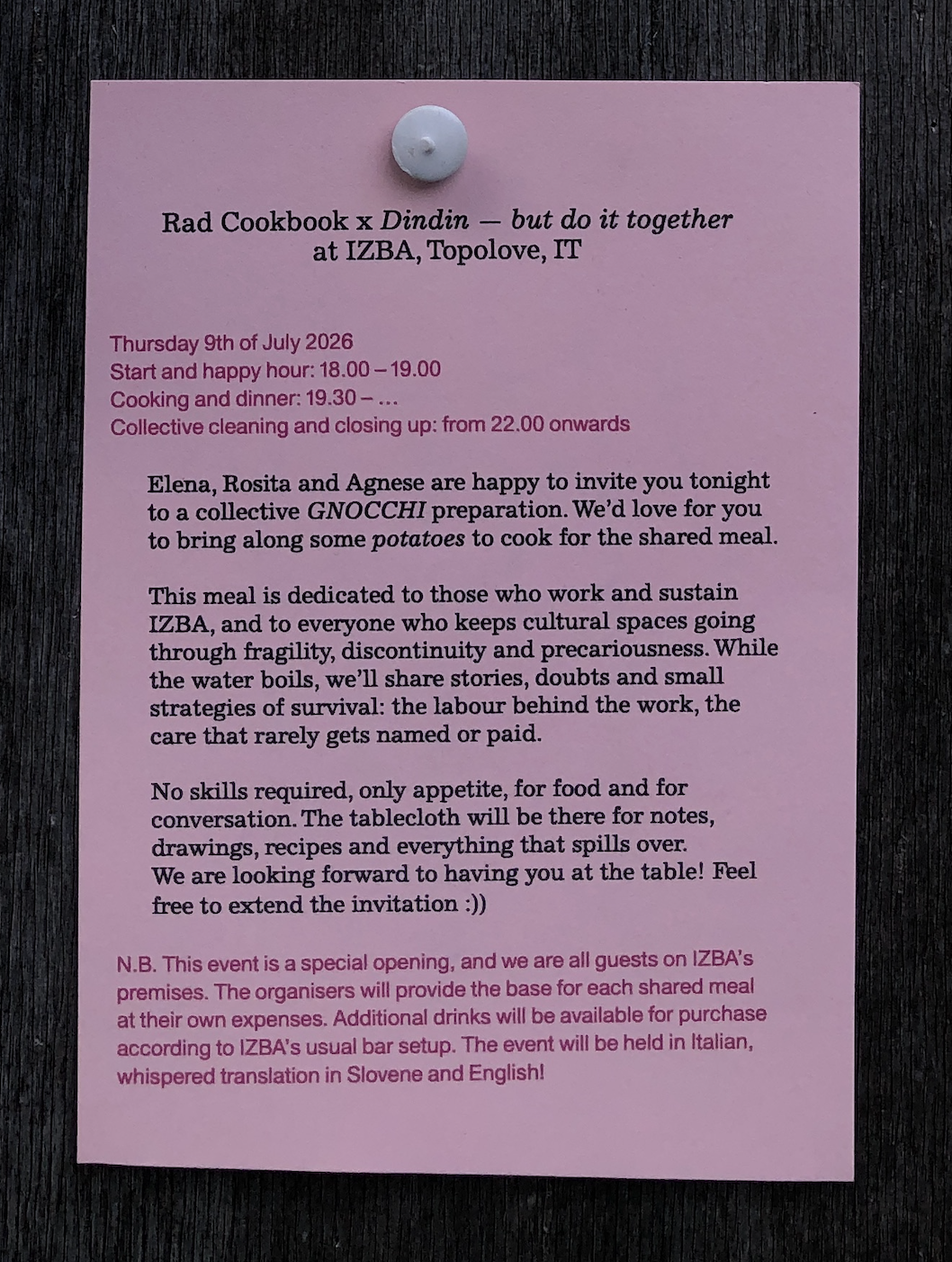
AP → Dindin* dinners offered a way for the questions we were developing within RAD to move beyond the three of us and be worked through with others. The series was already underway at IZBA as part of Elena’s residency, and during our stay we began to shape some of the evenings together. They brought together people living in Topolò, people close to Robida and friends passing through its wider circle, so that each dinner gathered a different mix of familiarity and new encounter.
The evenings began from a few simple propositions. There was a space to care for, a table around which food and conversation could gather, and a meal prepared just enough to leave room for what others might bring. Questions were placed on the table too, without knowing whether they would be taken up or where they might lead. Together, these elements gave the evenings an initial shape while leaving them responsive to who arrived, how people entered the space, and the relationships already unfolding around IZBA.
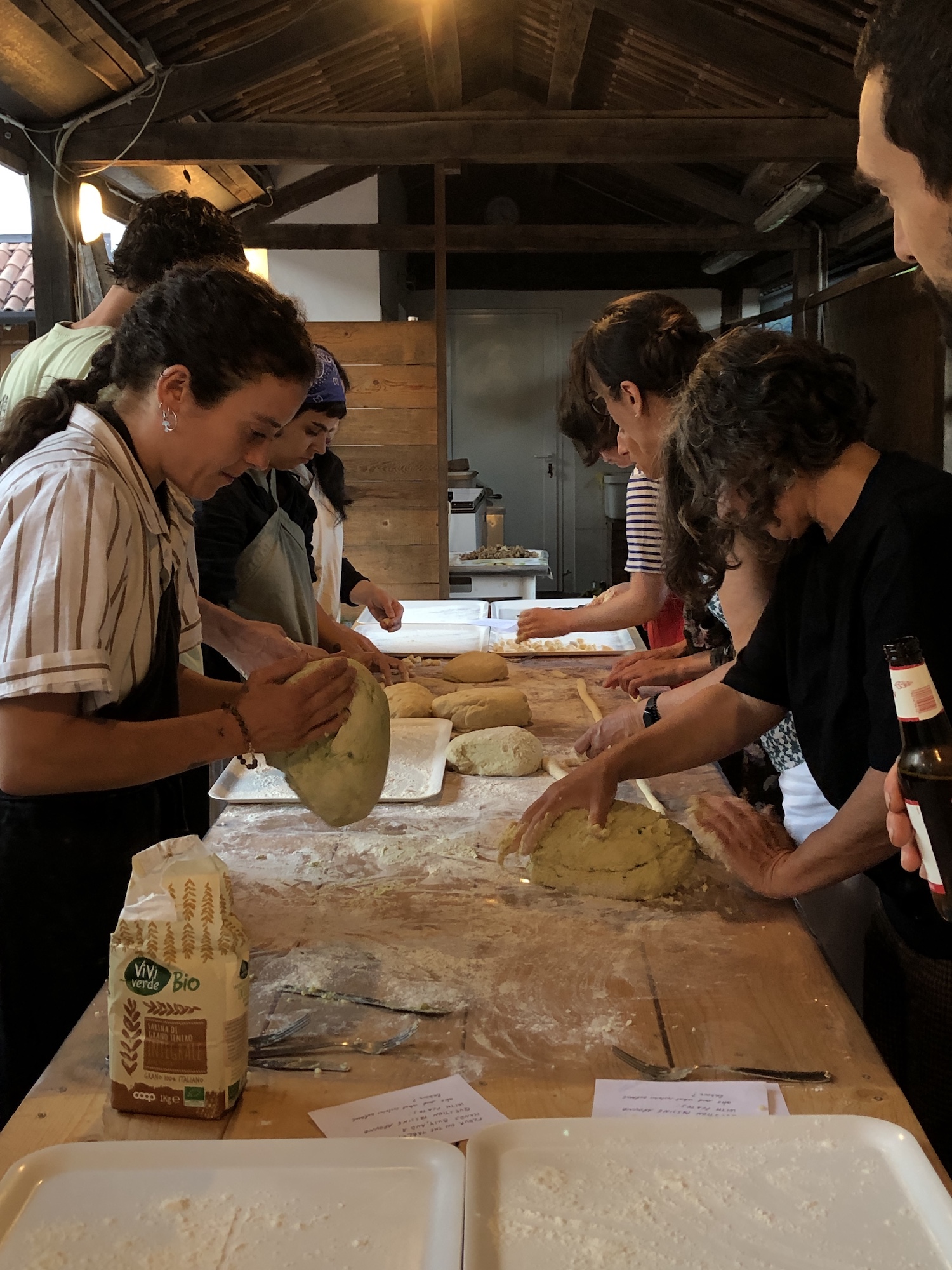
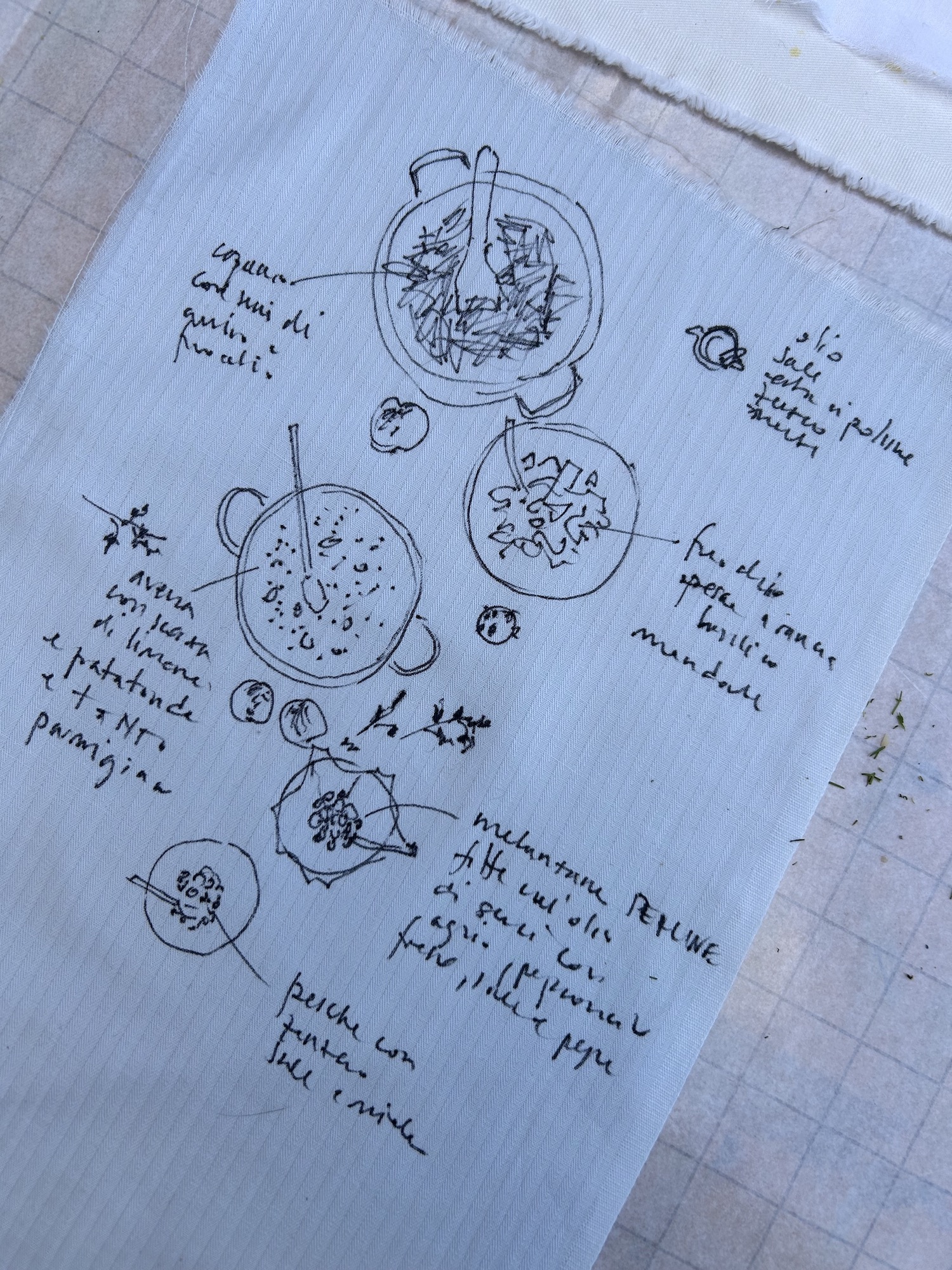
EB → *Dindin — but do it together was a series of midweek dinners organised during my summer-long residency at IZBA. Every Monday and Thursday, from 18:00 onwards, throughout July and August, I opened IZBA’s doors for a convivial meal. The idea behind these gatherings was to invite anyone to join with an ingredient of their choice, without any prior agreement on what meal would be prepared** or who would come along that day. I would prepare a base, preferably a cooked grain or cereal, often accompanied by starchy vegetables and seasoned with generous amounts of locally foraged wild herbs, parmesan cheese and lemon zest. This base functioned as a nourishing foundation to which fragments of meals could be added, hidden inside, or allowed to bypass it altogether. The intention behind the initiative was to spark new practices capable of weaving new material and conceptual ways of sharing IZBA with its inhabitants and others. I wanted to explore what kinds of dynamics might emerge around the space of the table—sometimes used as a preparation surface, a gathering point for Dindin, or a blank canvas for drawing our impressions—shaped by difference, responsibility and reciprocity. It was a space in which attentiveness to the needs and ingredients of others could extend beyond the simple relationship between an already-prepared meal and a passive guest. During the many Dindin occasions people brought for example: fennel flowers; clams for gnocchi; foraged porcini; old potatoes; fresh sage leaves; frozen wild garlic pesto; tegoline—green beans; melanzane perlina—long aubergines; beer; natural wine; kombucha; old mushy pumpkins; smocked and spicy paprika spice; oranges; peaches; basil plants; parmesan; all kinds of flour; chips; eggs; fresh rosemary; raffaello, and even one Topodollaro. (3)
**This is not entirely true—at a certain point, we began to wonder whether we could revive the infamous Italian culinary saying “Giovedì gnocchi”—Thursday’s gnocchi. After discussing it together, we decided to give it a try. Before long, Thursdays became devoted to gnocchi, and occasionally someone would offer to bring an extravagant ingredient for the sauce. Only then would I invite others to join and ask them to bring specific ingredients to complement the gnocchi or the sauce.
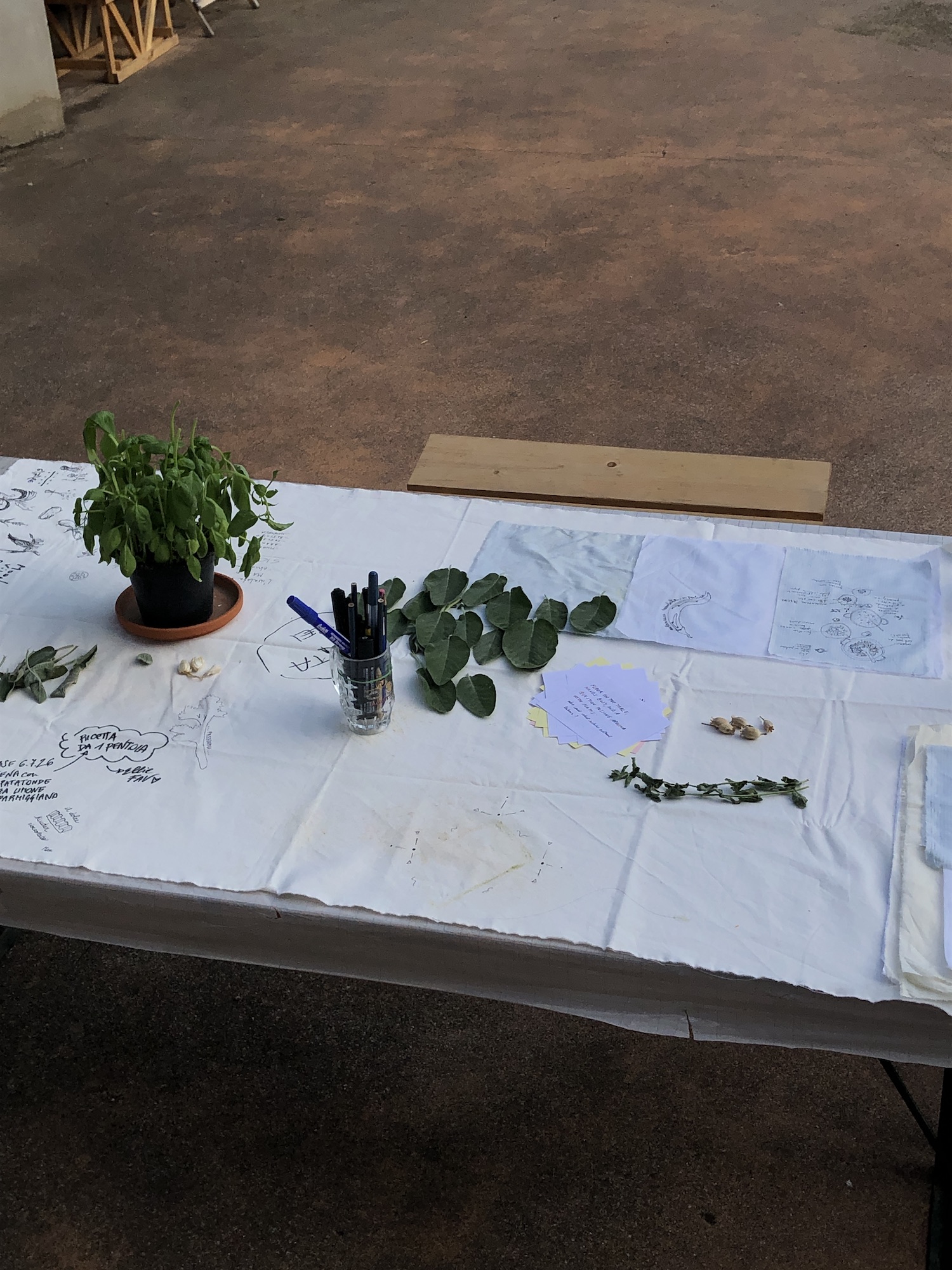
AP → As the evening unfolded, conversations moved continually between kitchen and table, dispersing into smaller exchanges and gathering again elsewhere. Participation could begin through preparing food, listening from another part of the space, moving between tasks, or simply arriving with an ingredient before any words were exchanged - and how quickly what we had imagined for the evening could be altered by the ways people inhabited it! The tablecloth stayed with us across the different dinners, gradually making more tangible something we had initially only sensed: that a shared surface could gather traces of these movements without fixing them, holding together fragments of the gathering while never fully containing what unfolded around it.
EB → As a textile artist, I have always been drawn to the potential of fabric and tailored tablecloths to frame, expand, and echo the spatial discourse of food processes. One of my favourite rituals in the Dindin series was setting the dining table, perhaps because we—RAD members and the inhabitants of Topolò—used the IZBA premises on a daily basis. Throughout the summer, the headquarters of the three local associations located in the village’s largest and main square, operated as a videoconference room, a venue for live projections of football matches, a dance club, a caffè, a frasca, a cinema, a peer-review room, a culinary workshop, a knitting room, a mensa, a budget-presentation space, a breakfast club, a venue for diarietto meetings, a concert hall, a public bathroom, a library, a local-product shop, a bulletin board, an event calendar, a bar, a restaurant, and much more. Moving things around to repurpose the space for each activity was therefore an integral part of IZBA’s daily schedule. The hours before Dindin were devoted to reconfiguring the setting. Although I loved the wooden furniture designed and built by Robida, it was cathartic to give the space a fresh tone by placing a piece of cloth over its horizontal surfaces. At first, the white cloth served as a blank canvas on which colourful summer produce, ingredients, flowers, and fresh herbs were arranged to create patterns or establish a welcoming atmosphere. As the weeks progressed, fragments of text, imprints, words, and drawings began to appear. Sometimes, our thoughts or collective questions were written down without ever receiving an answer. The simple act of recording our urgencies and thoughts became a tool for understanding what we were thinking, what we were looking at, how we were seeing things, and perhaps what it all meant to us. It helped us remember who we were, together, in that very moment.
RR → IZBA gradually became a space in which different ways of being present could coexist. The tablecloth, already marked by food, notes, drawings and traces of previous evenings, offered one surface through which those presences could register without requiring the same kind of participation from everyone. Some people entered through conversation, others through cooking, an ingredient, a gesture, or simply by remaining close to what was happening. I was struck by how these quieter forms of participation could alter the atmosphere of the room, allowing proximity and trust to build without demanding constant verbal exchange. In this sense, care emerged less as something explicitly organised than through the ways people adjusted to one another, made room, and sustained the gathering together.
AP → Across these shifts in space, atmosphere and participation, we began to think of hyper-conviviality as a way of describing the particular density that could emerge through being together. Different forms of presence, attention and responsibility accumulated within the same situation, making the conditions that sustained conviviality more perceptible. Its generative potential was carried through this intensity, together with the frictions and negotiations through which different bodies, needs and ways of participating found room alongside one another. This density also made us more aware of our own positions within the gathering, and of how differently each of us approached the work of holding it open.
AP → The gatherings at IZBA also brought our different approaches to facilitation into relation. The loose structure of the dinners depended on a continual adjustment between what we had prepared and what the gathering itself was producing. Questions could be introduced, deferred or left aside as attention moved through the room, while at other moments the rhythms of cooking and eating were already carrying the encounter further than any prompt we had prepared.
EB → In a way, Dindin enabled us to reconnect with our individual and collective pasts while responding directly to the food processes unfolding in the present. It felt like drifting through space: each time we began an event, we were different practitioners by the time it ended. Through our facilitation prompts—scripts, expectations, and questions designed to whisper—and the shared experience of preparing a communal meal, with its gestures, skills, diverse culinary traditions, and personal stories, we returned to an earlier self while simultaneously weaving a new culinary layer into it. These relational shifts have clarified the multifaceted forms of attentiveness and care that RAD must embrace—or release—leaving behind a halo of reflection and wonder at the ways food can serve as a catalyst for conviviality.
AP → The limits of our own frames became particularly apparent when people joined who did not share the professional language through which contemporary art or participatory practice often explains itself. Their presence brought some very basic questions back into view: what exactly were we doing together, why were we inviting people to cook, and where did we imagine the research to be taking place? Food allowed these questions to be approached through another register. Preparing, tasting, asking a practical question or simply remaining close to what was happening could become ways of entering the situation, allowing reflection to emerge through participation without needing to be announced or translated into a shared vocabulary in advance.
EB → RAD’s participation in the Dindin series was intended to facilitate the spontaneous yet unusual act of co-creating a ‘blindfolded’ meal. (4) At times, the dinner companions—many of whom were strangers to one another—seemed mildly uncomfortable because they did not know which recipe or what precise instructions to follow. This sense of disorientation was directed back toward us, as we were the event’s only point of reference. Occasionally, one of us would take the lead by encouraging someone to engage with the culinary process, offering subtle hints about how to proceed—or suggesting that they refrain from doing so. In this context, reciprocity and consensus became especially important.
From my perspective, the greatest challenge was surrendering to the possibility of facilitating a co-creative culinary event without taking the lead. This challenge became an opportunity: by making these dynamics visible, while collaborating with Rosita and Agnese, I was able not only to reflect on how my actions affected the group dynamic but also to learn being vulnerable with them by sharing and acknowledging my gaps. The lingering feeling of failure — i.e. not addressing enough of the questions on the table, fast forwarding steps of the recipe due to IZBA’s opening schedule, not noting down important aspects of the dinner, avoiding repetitive scripts and processes — discussed as a source of discovery became an encouraging thought. I feel that our attunement emerged through our individual practices of care and our shared interest in co-creating and working within a reciprocal environment, further strengthened by sharing the everyday routine in Topolò.
AP → The prompts we had prepared began, in this sense, to work in more than one direction. They could orient the gathering, recede when they were no longer needed, or return to us as a way of examining what we were trying to make possible. Facilitation also exposed the differences between our own instincts and habits, asking us to remain responsive both to one another and to the situation taking shape around us. The structure we had imagined therefore remained provisional, acquiring its usefulness through the ways it could be adjusted, relinquished or reworked in response to what the gathering required.

AP → Food moved through these gatherings in several registers at once. At times it brought memories, habits and attachments directly into conversation; at others it receded almost completely as a subject while continuing to organize what was happening through preparing, waiting, tasting and eating together. Its familiarity allowed people to approach the gathering from very different positions, through skill, appetite, curiosity, preference, refusal or memory, and conversations could begin from there without requiring everyone to enter through the same discursive register.
RR → Working with food in this way meant experiencing a deeply embodied form of knowledge. The recipe was never a rigid instruction, but an open space of negotiation: we adapted to whatever was available, adjusting quantities by eye, tasting, and correcting together. Within this vulnerability of the incomplete dish—which took shape only through the arrival of others—food operated as a silent translator. It allowed personal memories, familial gestures, and diverse culinary habits to meet without hierarchy. It didn't matter what each person brought to the table, whether a prized ingredient, a handful of herbs, or simply the willingness to wash the pots: every gesture carried equal weight, proving that collective care is not measured by the equivalence of an exchange, but by the readiness to sustain the moment together.
AP → Around the table, recipes often opened onto the circumstances in which they had been learned and repeated. What had once been affordable, who had been expected to cook, how something had been adapted through scarcity or habit, and who had passed it on could surface through the smallest detail. A quantity judged by eye could carry the trace of another generation; a particular preparation could hold years of domestic knowledge without ever having been written down.
These conversations made the act of sharing a recipe feel more intimate than the exchange of instructions. Something of another person’s time and history was being entrusted to us, with no guarantee that it would remain unchanged. In Topolò, this resonated with the way practical knowledge seemed to persist through use and proximity, carried across generations and sustained by people continuing to remember, repeat and care for what had been handed to them. Receiving something in this way also meant entering a relationship with it.
That sense of entrustment gradually extended to the gathering itself. Attention moved between people as the evening unfolded, and so did the responsibility for sustaining it. The question of who was hosting became less stable.
RR → This dynamic also reshaped our understanding of hospitality, moving it away from a service-oriented logic toward an active, shared condition. When hospitality is no longer about someone providing for someone else, the boundary between host and guest dissolves into a space of shared accountability. Food, in this sense, becomes a tool for unlearning rigid institutional habits: it forces us to slow down, to listen through our senses, and to accept the unpredictable nature of gathering without a predetermined script.
Ultimately, cooking and eating together at IZBA showed how micro-politics are practiced in everyday life. The quiet acts of chopping, stirring, passing a plate, or sitting in silence beside someone while sharing a meal are not merely background logistics; they are the very core of how relationships are built, tested, and sustained over time.
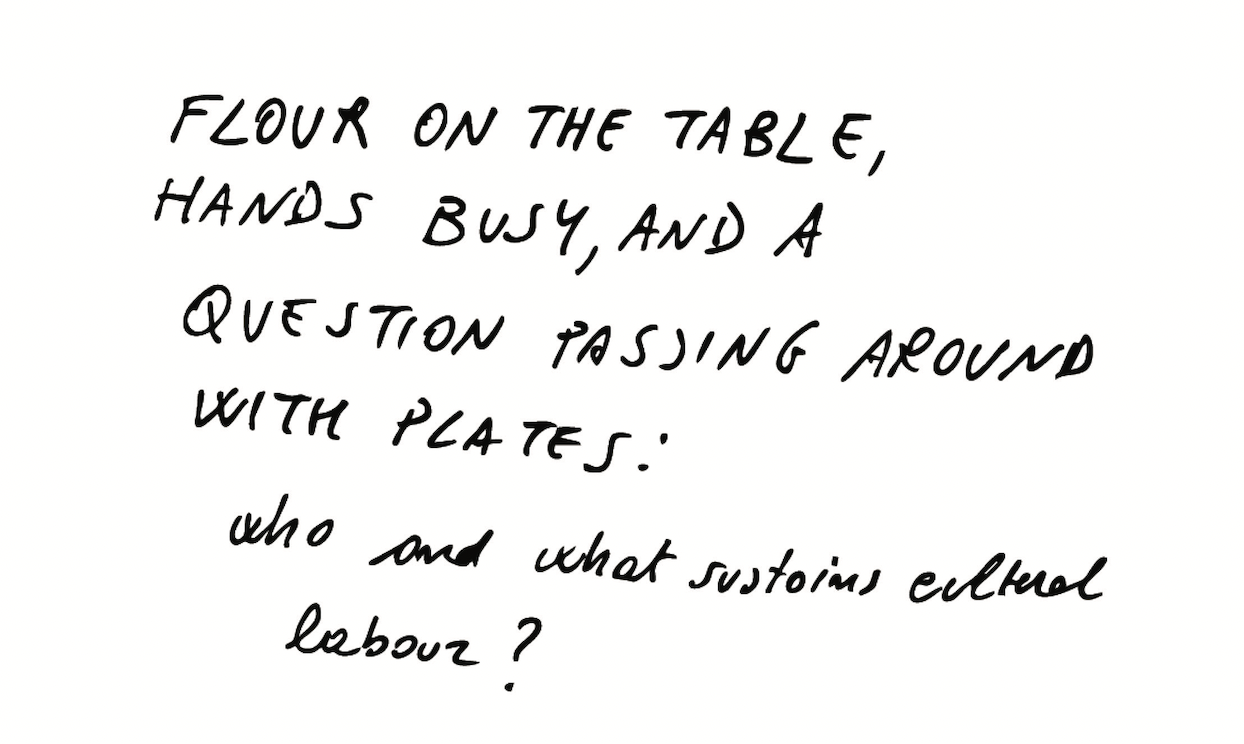
AP → Who, and what, sustains cultural work? We placed this question on the table during one of the dinners, and the conversation moved across Robida, RAD, as well as the personal histories and individual practices of those present. What surfaced were the conditions through which cultural work becomes possible and can continue over time: the material possibility of sustaining a practice, the pressures of other work and responsibilities, and the moments when care, exhaustion or changing circumstances reshape what someone is able to hold. Speaking about these experiences together made visible how deeply conditions often treated as personal are woven into the continuity of cultural work.
RR → Cleaning up together after the guests had left often became one of the most intimate and reflective moments of the night. As we washed the heavy pots, wiped down the tablecloth, saved leftovers and returned the room to another state, the intensity of hosting gradually gave way to a quieter form of debriefing. Reproductive labour became part of how we processed what had happened, noticing who had carried what during the evening and what still needed attention. Caring for the physical space and attending to our relationships often happened through the same gestures, giving maintenance a place within the collective experience rather than leaving it outside the frame of the gathering.

AP → What came into focus here was the politics of continuity itself. A collective practice is sustained through people whose capacities to remain present inevitably change over time, and its durability depends partly on whether those changes can be absorbed without becoming silent obligations for others. Sustainability therefore also concerns the possibility of renegotiating presence, responsibility and commitment as the lives supporting a practice shift.
AP → What remains from Topolò is difficult to locate in any single moment. Some things became explicit while we were there; others seem to have entered our practices more quietly and may only become legible later. Sedimentation gives us a way of staying with this uneven temporality, with what settles through proximity, repetition and shared time before finding another form.
RAD Cookbook already offers a place for such passages. Recipes arrive carrying voices, gestures and memories that have travelled through other hands, sometimes entrusted through stories that were never intended to become formal records. Topolò adds another layer to this ongoing archive, including what was shared with us, what we absorbed together, and what may reappear differently as the work continues.
The resonance of radix, the root contained in radical, feels particularly close here. Around Robida, rootedness lived alongside return, circulation and the continual comings and goings that nourish a place over time. Perhaps something similar can remain with the cookbook: a way of carrying things onwards while retaining enough of their histories and relationships for their roots to remain perceptible.
(1) Definition of ‘Residency’ from Robida’s website, glossary section. Written by Vida Rucli, 2021.
(2) We use this term because it resonates with Robida’s Academy of Margins and the Topolò summer program. Drawing on artist Fritz Haeg’s words, we, as artists and creatives, shall not arrive as empty vessels waiting to be filled. Nor is the land an empty space waiting to be ‘completed’. Rather, both the land and we are active agents in a school that we create together, embracing the daily chores and tending the infrastructures we temporarily inhabit. In a way, we are all schools—learning and teaching simultaneously to each other.
(3) Topodollaro is a fictional currency—a collectible banknote included as a free gift with select Topolino Disney magazines. This sparked hilarious conversations at the table about the possibility of creating a fictional Topolò currency. Now this memento is framed and exhibited in IZBA, close to the cash register.
(4) What I refer to as co-creating a ‘blindfolded meal’ is the process of collaboratively preparing a meal from the ingredients brought to the event. It is blindfolded because no one knows in advance what the other participants will bring or what resources will be available.
RAD Cookbook is a mobile, site-specific research project that uses food as a method for anticolonial inquiry, intergenerational care, and spatial practice. Developed by a constellation of practitioners in Italy — artists, curators, designers, farmers, and researchers — it moves through rural kitchens, migrant tables, and community ovens to trace how foodways hold histories of resistance, belonging, and transformation. RAD Coobook is a collaboration between Elena Braida, Agnese Politi and Rosita Ronzini.